The Data Architecture Behind LEED v5: What Real Estate Operators Need to Track
LEED v5 reframes certification around decarbonization, equity, resilience, health, and ecosystems. Each pillar demands a different data model. Here is what real estate operators need to instrument before the standard becomes default.
 Nitin Jain
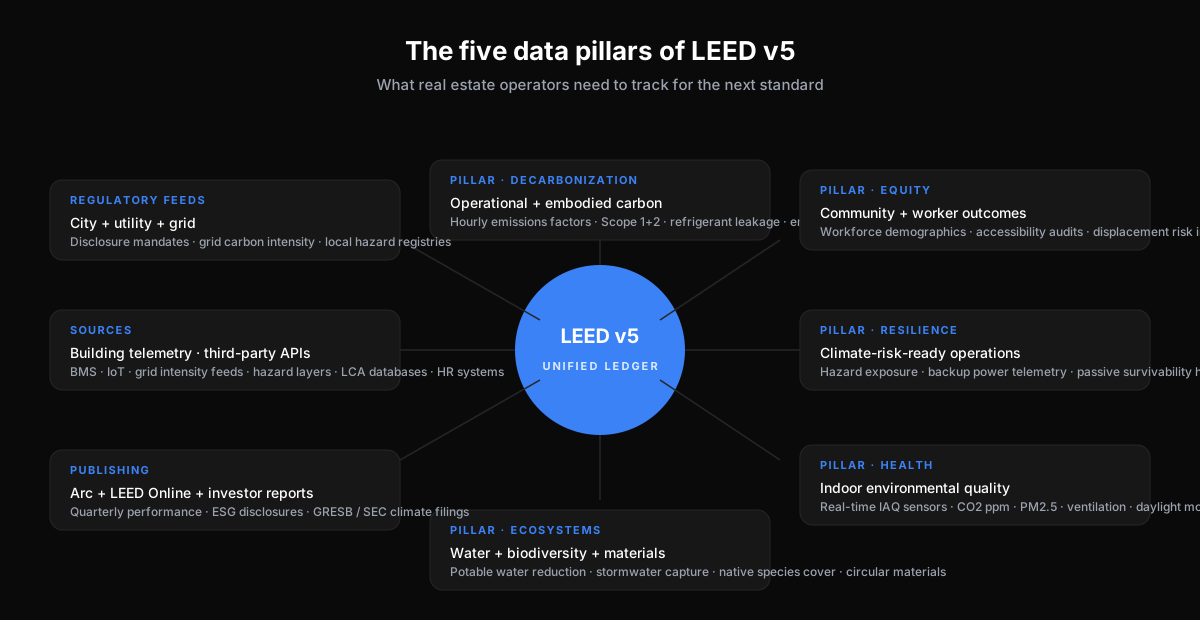
LEED v5 is a meaningful break from v4. Where v4 was structured around credit categories that mapped roughly to building systems (Energy + Atmosphere, Water Efficiency, Indoor Environmental Quality), v5 reorganizes around impact areas — decarbonization, equity, resilience, health, and ecosystems — and demands continuous performance data rather than point-in-time documentation.
For real estate operators, this is a data engineering problem first and a sustainability problem second. The buildings that certify well under v5 will be the ones whose data infrastructure is already capturing the right signals before the standard becomes default. The buildings starting from a static spreadsheet will find themselves a year behind their peers.
This piece walks through what data each impact area actually requires, where the sources live, and how to model it.
The Five Impact Areas
Pillar 1: Decarbonization
The big shift is from kWh to tonnes CO2e. v5 wants you to report not just how much energy you used, but the carbon intensity of that energy at the time you used it. A building running its chillers at 2 PM in California in summer has a very different emissions profile than the same building running them at 2 AM in Quebec in winter.
The data this requires: hourly grid emissions factors from your local ISO or utility (WattTime and Electricity Maps both publish APIs), hourly building consumption data from your BMS or revenue meter, refrigerant leakage logs (Scope 1), and embodied carbon from material LCAs for any major capital work. You need a time-series store — not a row-per-month spreadsheet — to multiply hourly consumption by hourly grid intensity and sum to tonnes CO2e.
Embodied carbon is the harder part. Most LCA tools (Tally, EC3, OneClick LCA) export structured data; you want to land those exports in your warehouse with project-level rollups so you can answer "what is the embodied carbon per square foot of our 2026 capital projects?"
Pillar 2: Equity
v5 expects buildings to demonstrate positive impact on the surrounding community and on the workers who construct, operate, and clean them. This is not a credit type that fits cleanly into a building automation system.
The data sources are organizational rather than physical: workforce demographics from HR systems, contractor and subcontractor diversity data from procurement, community engagement records from your stakeholder relations team, accessibility audit results from facilities, and displacement risk indicators from public datasets like the U.S. Census or municipal equity scorecards.
The architecture challenge is that none of these sources naturally talk to your building data warehouse. The operators who get this right build a thin equity data mart that joins HR data, procurement spend, and external geographic data into a single per-property view.
Pillar 3: Resilience
Climate-risk exposure has gone from a niche concern to a central LEED requirement. v5 wants to know how your building survives a power outage, a flood, a heatwave, or a wildfire smoke event.
The data this requires: geographic hazard layers from FEMA, NOAA, or equivalent national agencies for flood, wildfire, hurricane, and extreme-heat exposure; backup power telemetry from your generators and batteries; passive survivability calculations — how many hours can the building maintain habitable temperature without grid power; and continuity-of-operations documentation tied to actual incident logs.
The pattern that works here is to land hazard layers as static reference data in your warehouse, joined to property location, then refresh annually. Telemetry data flows continuously from BMS. Event logs (outages, smoke days, heat waves) need a manual entry surface — usually a thin internal app — that operators actually use.
Pillar 4: Health
Indoor environmental quality moves from periodic third-party verification (v4) to continuous sensor-based monitoring (v5). You need real-time data on CO2 ppm, PM2.5, VOCs, temperature, humidity, and ventilation rates — not a single test conducted on a Tuesday morning in October.
For new buildings this is straightforward — IAQ sensors are now affordable enough to install in every zone. For existing buildings the retrofit is the hard part. Networks like Awair, Kaiterra, and AirThings publish APIs you can ingest into your time-series store. Most BMS vendors now offer IAQ modules that integrate with your existing controls network.
On the data side, what matters is the aggregation policy. Hourly averages mask short spikes; minute-level data is too noisy to compare across buildings. v5 documentation guidance is settling on percentile metrics — what percent of occupied hours did CO2 stay below 1000 ppm — which require minute-level inputs and percentile calculations in your transformation layer.
Pillar 5: Ecosystems
Water, biodiversity, and material flows. The traditional water credits — potable consumption reduction, stormwater management — get joined by new credits around native species cover, on-site biodiversity, and material circularity.
The data sources are mixed: water meters for potable consumption, stormwater system telemetry for capture and treatment, landscaping audit data (often manual surveys) for native species cover, and procurement + waste hauler data for material circularity (what came in, what went out, what was reused on-site).
The procurement side is where most operators have the least mature data. ERP systems were built for cost, not for material composition. A circular materials credit requires you to know that a piece of equipment contains 30% recycled aluminum — which means you need supplier-level material declarations (HPDs, EPDs) joined to your purchase orders. Most teams will need a separate ingestion pipeline for these supplier documents.
A Unified Ledger, Not Five Spreadsheets
The temptation is to address each pillar with a separate tool — an energy-monitoring SaaS for decarbonization, an HR report for equity, a hazard-mapping vendor for resilience, an IAQ vendor for health, a CSR tracker for ecosystems. That works at one building. At a portfolio of 50 it becomes unmanageable.
The architecture pattern that scales is a unified building ledger in your warehouse — one row per property, time-series tables for every signal, and modeled views per pillar that roll signals into LEED-credit-shaped outputs. From the same ledger you can also produce GRESB submissions, SEC climate disclosure data, investor ESG reports, and tenant sustainability asks. The pipeline pays for itself across compliance regimes.
What to Build First
If you are starting from a typical "spreadsheets and email" baseline, build in this order: energy + carbon first (largest credit weight, ESPM gets you most of the way), then health (IAQ retrofits have short payback and tenant-marketing value), then resilience (insurance and lender pressure are forcing it anyway), then ecosystems, then equity. Equity is last not because it is unimportant, but because it requires organizational data work that benefits from having the technical pipeline already in place.
The teams that win under v5 are not the ones that bolt on more sustainability tools. They are the ones that treat building performance as a first-class data problem and build the warehouse, models, and tests to match. The standard is going to keep moving. The data infrastructure should be ready for it.
Frequently Asked Questions
When does LEED v5 become required?
LEED v5 is in active rollout. New project registrations under v4.1 are still accepted but the USGBC has signaled v5 will become the default for new registrations within the next certification cycle. Operators who certify under v4.1 today will face a v5 path on re-certification.
What is the biggest difference between v4 and v5?
Two things: v5 is organized around outcomes (decarbonization, equity, resilience, health, ecosystems) rather than building systems, and v5 expects continuous performance data rather than point-in-time documentation. Buildings need data infrastructure that updates monthly or daily, not annually.
How does v5 change what data I need to track?
You move from kWh to tonnes CO2e (requires hourly grid intensity), from periodic IAQ verification to continuous sensor data, from project-level resilience narratives to quantified hazard exposure and survivability hours, and add equity data sources (workforce demographics, contractor diversity) that did not exist in v4.
Can I use the same pipeline for GRESB and SEC climate disclosure?
Yes — and you should. The underlying signals overlap heavily. A unified ledger that holds your building performance time-series feeds LEED, GRESB, SEC climate disclosure, ESG investor reports, and tenant sustainability requests from the same source of truth. The economics of a single pipeline across compliance regimes are very strong.
Need help building your data platform?
At CData Consulting, we design, build, and operate modern data infrastructure for companies across North America. Whether you are planning a migration, optimizing costs, or building from scratch — let's talk.
Get data engineering insights delivered to your inbox
Join our newsletter for weekly insights on Snowflake, data architecture, and modern analytics.