ESG in Real Estate: How Data Pipelines Power Green Building Certification and Compliance
Real estate portfolios face growing ESG mandates. Here is how modern data infrastructure turns sensor feeds, utility data, and tenant surveys into audit-ready certification evidence.
 Nitin Jain
Commercial real estate is one of the most data-intensive industries when it comes to Environmental, Social, and Governance (ESG) compliance. Buildings account for roughly 40% of global carbon emissions. Investors, regulators, and tenants are now demanding proof — not promises — that portfolios are meeting sustainability targets. The gap between having the data and being certification-ready is a data engineering problem.
We have worked with property management firms and REITs that had energy meters on every floor, water sensors in every building, and waste tracking at every dock — but could not produce a single audit-ready ESG report. The data existed in dozens of disconnected systems: BMS platforms, utility portals, tenant survey tools, and spreadsheets maintained by facility managers. The problem was never data collection. It was data integration, normalization, and lineage.
The ESG Certification Landscape for Real Estate
There are several major certification and reporting frameworks that real estate portfolios need to track. Each one requires a different cut of the same underlying data, reported in different formats, with different temporal granularities.
LEED (Leadership in Energy and Environmental Design) — The most widely recognized green building certification. LEED v4.1 for Existing Buildings uses the Arc platform for ongoing performance scoring across energy, water, waste, transportation, and human experience. It requires monthly or quarterly meter data uploads with specific normalization rules (energy use intensity per square foot, weather-adjusted baselines).
GRESB (Global Real Estate Sustainability Benchmark) — The dominant ESG benchmark for real estate investors. Over 1,800 property companies and funds report annually. GRESB uses a 0–100 scoring system with peer-relative benchmarking across Management, Performance, and Development components — your score reflects both absolute performance and how you rank against comparable portfolios. It requires asset-level data: energy consumption by fuel type, water withdrawal by source, waste by disposal method, GHG emissions (Scope 1, 2, and increasingly Scope 3), and social metrics like tenant engagement and health certifications.
ENERGY STAR Portfolio Manager — The EPA benchmarking tool used across the US and Canada. Properties receive a 1–100 score based on source energy use intensity compared to similar buildings. Many municipal benchmarking ordinances (Toronto, New York, Vancouver) require annual ENERGY STAR reporting by law. The data requirement is straightforward: 12 months of continuous utility data per meter, with no gaps exceeding 120 days.
TCFD (Task Force on Climate-related Financial Disclosures) — Now mandatory for federally regulated financial institutions in Canada and increasingly expected by institutional investors globally. Requires forward-looking scenario analysis, not just historical reporting. Data teams need to model climate risk exposure across the portfolio using location data, building characteristics, and climate projection datasets.
Canada-specific: Federal Greening Government Strategy and BERDO-equivalent municipal bylaws — Canadian federal buildings must reach net-zero by 2050. Toronto’s Energy and Water Reporting and Benchmarking (EWRB) bylaw requires annual reporting for buildings over 50,000 sq ft. Vancouver’s Building By-law mandates energy benchmarking and emissions limits. These regulations are tightening every year, and non-compliance carries financial penalties.
Why This Is a Data Engineering Problem
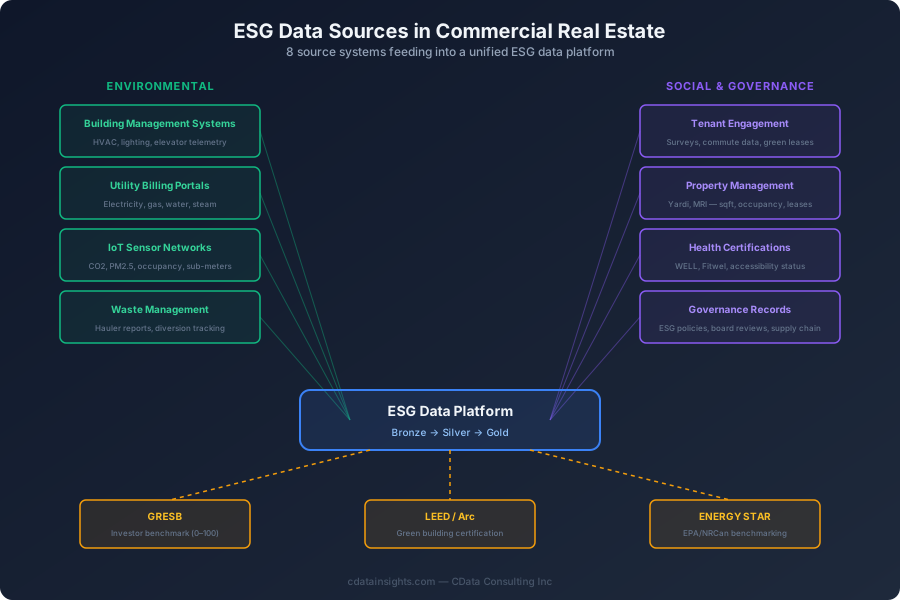
The challenge is not that ESG data does not exist. It is that it exists in the wrong shape, in the wrong place, at the wrong granularity. A typical commercial real estate portfolio generates ESG-relevant data from at least eight distinct source systems.
Building Management Systems (BMS) — Honeywell, Siemens, Johnson Controls, or Schneider Electric platforms that capture HVAC, lighting, and elevator telemetry. These systems produce high-frequency time-series data (often sub-minute intervals) in proprietary formats. Most BMS platforms expose data via BACnet, Modbus, or vendor-specific APIs that require custom integration.
Utility billing portals — Electricity, gas, water, and steam bills from dozens of utility providers across a geographically distributed portfolio. Each utility has its own billing format, billing cycle, unit of measure, and rate structure. A single building might have 15 meters across 4 utility types.
IoT sensor networks — Indoor air quality sensors (CO2, PM2.5, VOCs), occupancy sensors, water flow meters, and sub-meters installed as part of smart building initiatives. These produce streaming data that needs to be aggregated to daily or monthly rollups for certification reporting.
Waste management systems — Hauler reports, weight tickets, and diversion tracking. Waste data is notoriously messy: different haulers report in different units (tons, cubic yards, number of pulls), and diversion rates require classification of waste streams (landfill, recycling, compost, construction debris).
Tenant engagement platforms — Satisfaction surveys, commute surveys (for LEED transportation credits), and green lease compliance tracking. Social metrics for GRESB require structured survey data with response rates and scoring.
Property management and lease systems — Yardi, MRI Software, or RealPage systems that hold the asset master data: square footage, occupancy, building type, year built, and lease terms. This is the reference data that every ESG calculation depends on for normalization.
Architecture: The ESG Data Platform
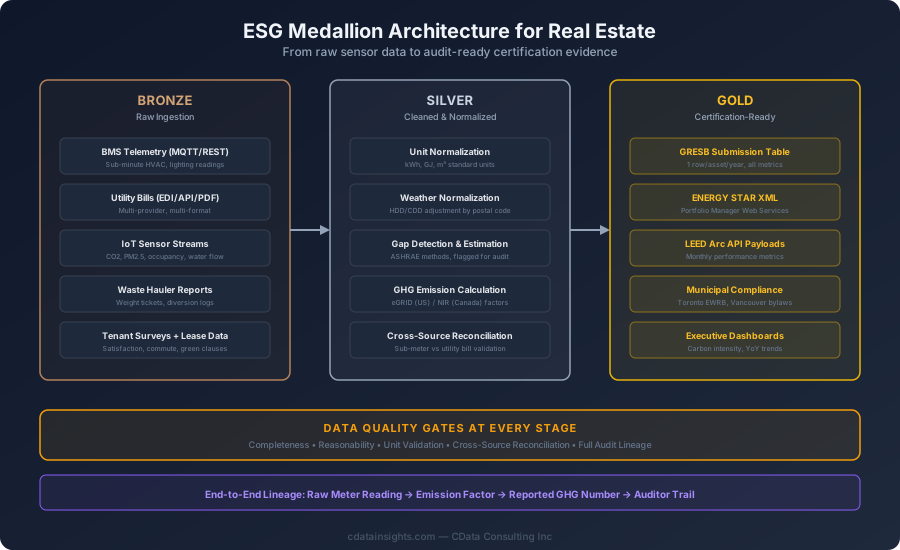
The architecture we recommend for ESG data in real estate follows the same medallion pattern (bronze/silver/gold) that works for any analytical data platform, but with specific adaptations for certification workflows.
Bronze layer (raw ingestion): Land data from all source systems in its original format. BMS telemetry arrives via MQTT or REST APIs and lands in a time-series store or object storage. Utility bills are ingested via EDI feeds, API integrations with platforms like Urjanet or ENERGY STAR Portfolio Manager Web Services, or PDF extraction pipelines. Waste hauler reports, tenant surveys, and property master data are pulled on their respective cadences. The key principle: never transform at ingestion. Preserve the raw data with full lineage metadata — source system, extraction timestamp, and data version.
Silver layer (cleaned and normalized): This is where the heavy lifting happens. Utility data is normalized to standard units (kWh for electricity, GJ for gas, cubic meters for water). BMS telemetry is aggregated from sub-minute readings to hourly and daily rollups. Gap detection runs automatically: if a meter is missing more than 5 days of data in a billing period, it gets flagged for estimation using ASHRAE-approved methods. Weather normalization is applied using heating degree days (HDD) and cooling degree days (CDD) from the nearest weather station, matched by postal code. GHG emissions are calculated using the appropriate emission factors — eGRID subregion factors for US properties, National Inventory Report factors for Canadian properties.
Gold layer (certification-ready): Pre-built datasets shaped exactly to the submission format of each certification. A GRESB gold table contains one row per asset per reporting year with all required fields populated: energy by fuel type, water by source, GHG by scope, waste by disposal method, and social metrics. An ENERGY STAR gold table contains the exact XML schema expected by Portfolio Manager Web Services for automated submission. A LEED Arc gold table contains monthly performance metrics formatted for the Arc API. The gold layer also produces the executive dashboards: portfolio-wide carbon intensity trends, year-over-year improvement tracking, and certification status by asset.
Data Quality Gates for ESG
ESG data has a unique quality requirement: it must be auditable. Unlike internal analytics where a 2% error might be acceptable, certification bodies and investors will audit your data. GRESB requires third-party assurance for top scores. LEED performance scoring is validated against utility records. Municipal benchmarking bylaws carry fines for inaccurate reporting.
We build specific quality gates into the pipeline. Completeness checks verify that every meter for every building has data for every billing period — gaps trigger automated estimation or manual review workflows. Reasonability checks compare current-period consumption against historical baselines: a building that suddenly uses 300% more water than last quarter gets flagged. Unit validation catches the most common ESG data error — mixing up kWh and MWh, or cubic feet and cubic meters, which produces order-of-magnitude errors in reported metrics. Cross-source reconciliation compares BMS sub-meter totals against utility bill totals to catch meter drift or misconfigured sensors.
Every transformation and calculation carries full lineage: which raw records contributed to each reported number, which emission factors were applied, which estimation methods were used for gap-filled data. When an auditor asks "where did this GHG number come from?" the answer is a traceable chain from the gold table back to the original meter reading or utility bill.
GHG Emissions: Scope 1, 2, and the Scope 3 Problem
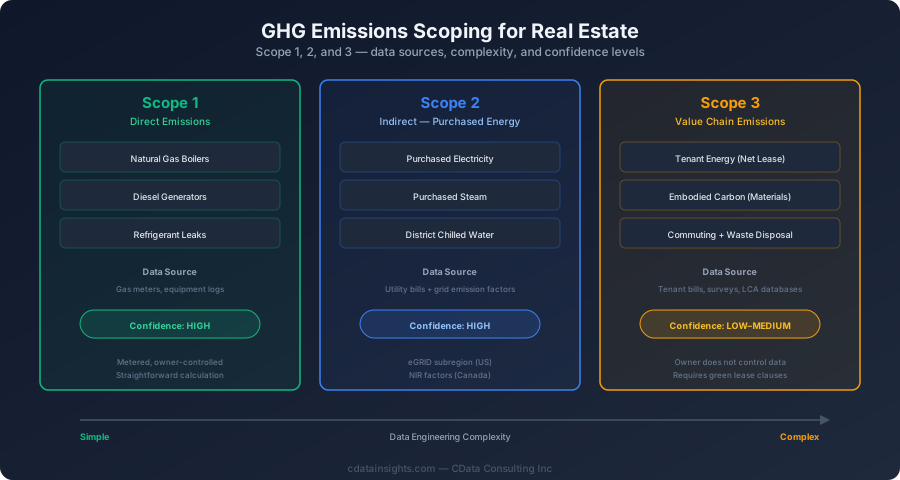
Greenhouse gas accounting is the core of ESG reporting in real estate. Scope 1 covers direct emissions from on-site combustion: natural gas boilers, diesel generators, and refrigerant leaks. The data source is straightforward — gas meters and equipment maintenance records. Scope 2 covers indirect emissions from purchased electricity, steam, and chilled water. This requires mapping each utility account to the correct grid emission factor, which varies by region and year.
Scope 3 is where it gets hard. For real estate, the material Scope 3 categories include tenant energy use in net-lease properties (where the landlord does not control the meter), embodied carbon in construction and renovation materials, employee and tenant commuting, and waste disposal emissions. Investor pressure for Scope 3 is growing rapidly — GRESB now asks for it, and the Canadian Securities Administrators are moving toward mandatory climate disclosure that will include material Scope 3 categories.
From a data engineering perspective, Scope 3 requires stitching together data sources that the building owner does not control: tenant utility accounts (often requiring green lease data-sharing clauses), commute survey data, and life-cycle assessment databases for construction materials. We typically build Scope 3 as a separate pipeline with explicit data quality tiers — metered data gets the highest confidence tag, survey-estimated data gets a medium tag, and spend-based estimates get a low tag. This transparency is critical for auditors and investors.
Automating Certification Submissions
The real ROI of an ESG data platform is not just having the data — it is automating the certification workflow. Without automation, a 200-building portfolio might have a team of 3–4 people spending weeks manually entering data into ENERGY STAR Portfolio Manager, exporting it for GRESB, reformatting it for municipal compliance, and assembling evidence packages for LEED audits.
ENERGY STAR Portfolio Manager has a well-documented REST API (Web Services) that accepts property and meter data programmatically. We build pipelines that push monthly utility data directly from the gold layer into Portfolio Manager, trigger score calculations, and pull back the computed scores for internal dashboards. For Canadian properties, the same API works with Natural Resources Canada’s ENERGY STAR Portfolio Manager instance.
GRESB accepts data via Excel templates or their API. We generate pre-filled templates from the gold layer with all asset-level metrics populated, validation checks pre-run, and evidence documents attached. What used to take weeks of manual data entry becomes a review-and-submit workflow.
Municipal compliance varies by jurisdiction but typically involves uploading to a city portal or submitting via ENERGY STAR sharing. We maintain a compliance calendar that tracks deadlines for each building by jurisdiction and triggers automated data preparation workflows 30 days before each deadline.
Real-Time Monitoring vs. Annual Reporting
Certifications are annual, but the data that feeds them should be monitored continuously. Waiting until Q1 to discover that a building’s energy consumption spiked in July means you have already lost the certification score — and the opportunity to intervene.
We build two monitoring layers. The operational layer processes BMS and IoT data in near-real-time to detect anomalies: a chiller running at 3 AM in an unoccupied building, a water meter showing continuous flow during a holiday shutdown, or indoor air quality dropping below WELL Building Standard thresholds. These trigger alerts to facilities teams for immediate intervention.
The certification projection layer runs monthly and models where each building will land on its ENERGY STAR score, GRESB score, and emission reduction targets at year-end based on current trajectory. If a building is trending below target, portfolio managers get early warning with enough time to implement operational changes — adjusting HVAC schedules, upgrading lighting, or negotiating renewable energy credits.
The Social and Governance Data Gap
Most ESG data platforms focus heavily on the E (environmental) and underinvest in the S (social) and G (governance). But GRESB scores weight all three, and investors are increasingly asking about tenant health, community impact, and board-level ESG oversight.
Social metrics that need structured data collection include: tenant satisfaction surveys (with response rates tracked as a quality metric), health and wellness certifications (WELL, Fitwel) per building, accessibility compliance status, community engagement programs, and diversity metrics for property management teams. These are often the hardest to collect because they involve human processes rather than automated sensors.
Governance metrics include: ESG policy documentation and review dates, board-level ESG committee meeting records, ESG-linked compensation structures, supply chain due diligence records, and green lease adoption rates across the portfolio. We model these as slowly changing dimensions in the data warehouse, tracked over time to show progress.
ROI: What the Data Platform Delivers
The business case for an ESG data platform in real estate is concrete. Certification scores improve — we have seen GRESB scores increase by 15–20 points in the first year after implementing automated data collection, simply because complete and accurate data eliminates the scoring penalties for gaps and estimation. Operational savings follow — real-time energy monitoring typically identifies 10–15% energy waste from scheduling errors, equipment faults, and base-load anomalies. Compliance risk drops — automated municipal reporting eliminates late filings and the associated fines ($500–$10,000 per building per year in major cities). Green premiums materialize — LEED and ENERGY STAR certified buildings command 5–10% rental premiums and 10–25% higher sale prices, but only if you can maintain the certification with ongoing data.
The teams that struggle with ESG are not lacking ambition or data. They are lacking the data infrastructure to turn raw building data into certification evidence at portfolio scale. This is fundamentally a data engineering challenge, and it is one that modern data platforms solve well.
At CData Consulting, we build ESG data platforms for real estate portfolios — from sensor ingestion to automated certification submission. If your team is manually assembling GRESB reports or struggling with ENERGY STAR data gaps, let’s talk about building the pipeline that does it for you.
Frequently Asked Questions
What ESG certifications matter most for commercial real estate?
The big three are GRESB (investor benchmark, scored 0–100), LEED (green building certification, uses Arc platform for ongoing performance), and ENERGY STAR (EPA/NRCan energy benchmarking, scored 1–100). Most institutional investors now require GRESB reporting, and many municipal bylaws mandate ENERGY STAR benchmarking for buildings over a certain size.
What data sources feed into ESG reporting for buildings?
The primary sources are building management systems (HVAC, lighting telemetry), utility billing portals (electricity, gas, water, steam), IoT sensor networks (air quality, occupancy, sub-meters), waste hauler reports, tenant survey platforms, and property management systems like Yardi or MRI Software for asset master data.
How do you handle data gaps in utility records?
ENERGY STAR allows gaps of up to 120 days per meter, but we apply a stricter internal threshold: we use ASHRAE-approved estimation methods for short gaps (under 5 days) and flag longer gaps for manual review. The pipeline tracks which data points are metered vs estimated, and this metadata flows through to the certification submission so auditors can see exactly which values were gap-filled.
What is the difference between Scope 1, 2, and 3 emissions in real estate?
Scope 1 is direct emissions from on-site combustion (gas boilers, generators). Scope 2 is indirect emissions from purchased electricity and steam. Scope 3 includes downstream emissions like embodied carbon in construction materials, commuting, and waste disposal. Tenant energy use may fall under Scope 3 depending on the GHG Protocol boundary — specifically whether the landlord has operational control or financial interest in the metered usage (common in net-lease structures). Scope 3 is the hardest to measure because the building owner often does not control the data sources.
Need help building your data platform?
At CData Consulting, we design, build, and operate modern data infrastructure for companies across North America. Whether you are planning a migration, optimizing costs, or building from scratch — let's talk.
Get data engineering insights delivered to your inbox
Join our newsletter for weekly insights on Snowflake, data architecture, and modern analytics.