How Cities Are Using Building Energy Data to Drive Green Certification at Scale
Mandatory disclosure laws are generating decades of building performance data. Here is the data architecture cities use to turn that raw disclosure into public scorecards that reshape commercial real estate markets.
 Nitin Jain
For most of the history of commercial real estate, a building's energy performance was a private fact between the owner and their utility company. That is changing fast. More than 40 North American cities now require commercial buildings above a size threshold to disclose annual energy and water consumption. Several have gone further and publish that data — building by building, in public, with searchable maps and visual scorecards.
These programs do something subtler than just shame underperformers. They create a market for performance information that did not exist before. Brokers cite scores in listings. Tenants ask for them in RFPs. Lenders factor them into refinancing. Green certification — LEED, BOMA BEST, ENERGY STAR — becomes a way to publicly answer the question the scorecard implicitly asks.
The data architecture behind these programs is interesting in its own right, and worth studying whether you are a city building one, an owner subject to one, or a consultant helping clients comply.
The Three-Layer Architecture
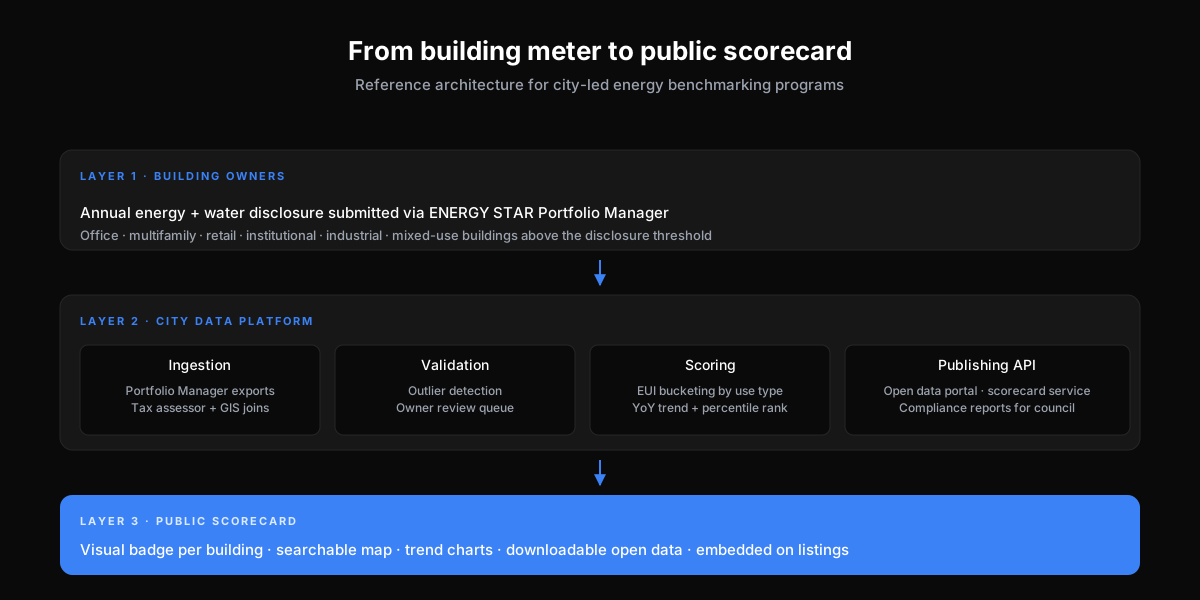
Almost every city benchmarking program — New York, Chicago, Toronto, Vancouver, Boston, Seattle, San Francisco — converges on the same three-layer pattern: building owners disclose, the city processes and validates, and a public scorecard publishes results. The implementations differ in tooling, but the data shapes are remarkably consistent.
Layer 1: Disclosure Through Portfolio Manager
Almost every city anchors disclosure on ENERGY STAR Portfolio Manager (ESPM). It is the de facto standard, EPA-maintained, and free. Cities require building owners to enter consumption data into their own ESPM accounts, then "share" their property record with the city's ESPM account on a defined schedule.
This design choice is doing a lot of work. By using ESPM as the disclosure surface, the city offloads weather normalization, site-vs-source EUI calculations, and property-use peer comparisons to EPA — and gets a normalized data feed they can ingest. The trade-off is that owners have to learn ESPM, and the user experience is famously rough.
The disclosure threshold matters. Most programs start with buildings over 50,000 square feet, then ratchet down. Toronto's program covers buildings over 50,000 sq ft today; Vancouver's drops to 25,000 sq ft. The smaller the threshold, the more buildings included, the larger the data engineering burden.
Layer 2: The City Data Platform
Once data lands at the city, four things have to happen: ingestion, validation, scoring, and publishing.
Ingestion means pulling from ESPM (via the EPA Web Services API or via scheduled ESPM "data request" templates), then joining against the city's authoritative property database — typically the tax assessor roll, plus GIS layers for parcel boundaries and zoning. The join is harder than it looks. Building IDs in ESPM are user-entered and frequently do not match assessor parcel IDs cleanly. Address normalization, fuzzy matching, and a manual review queue are required for the long tail.
Validation catches the obvious problems before they become public embarrassments. Outliers — a 50,000 sq ft office reporting 12 kWh/sq ft annual consumption (about 1/3 of normal) — get flagged for owner review. Data completeness checks ensure all 12 months are reported. Square footage sanity checks compare reported floor area against assessor records. Most cities give owners a window to correct flagged data before publication.
Scoring is where the program's personality shows. Some cities publish raw EUI numbers and let the market interpret. Others (Chicago, Toronto) publish a 1-to-5-star or A-to-F letter grade based on percentile rank within the building's use type. Letter grades are more interpretable to non-experts and create a stronger market signal — but require the city to take a position on what "good" means, which can be politically fraught.
Publishing is the last mile. The data goes into the city's open data portal (CSV download, plus an API) and into a dedicated scorecard application — a searchable web app that lets anyone look up any covered building. The scorecard is what residents, brokers, journalists, and competitors actually see, so its UX matters enormously.
Layer 3: The Scorecard as Market Signal
A scorecard does three jobs at once. It informs the public. It pressures owners. And it creates a baseline that LEED and other certifications are measured against.
New York City's Local Law 33 grade — a letter posted physically on the building entrance — is the most aggressive version. Chicago's Energy Benchmarking Report and Toronto's emerging program are gentler but follow the same logic. Once a building has a public score, the conversation about LEED certification changes from "should we?" to "we have to — our score is a D and our competitor across the street is a B".
For LEED specifically, public scorecards accelerate adoption of LEED for Existing Buildings (O+M) and v5 because both standards are explicitly performance-based. A building cannot fake a public ESPM score the way it might fake a one-time submission narrative.
What Owners Should Do About It
Get ahead of disclosure. If your city is heading toward mandatory disclosure (and most are), set up your own ESPM presence now. Discover what your score is going to be in private, before it goes public. The first published score sets a baseline that anchors public perception for years.
Build the same pipeline cities build. Owners who can see their portfolio the way the city sees it — same normalization, same percentile ranks — can make capital allocation decisions about which buildings need retrofits and which need certification efforts. The scorecard is also a roadmap.
Treat the scorecard data as a marketing asset. If your buildings score well, surface that. Embed scores in listing pages. Cite them in lease negotiations. The cities are doing the marketing work for you — meet it halfway.
Plan for re-disclosure cycles. Disclosure is annual. Letter grades update annually. A building that improved last year and slipped this year tells a story. A pipeline that updates ESPM monthly catches drift before it shows up on the scorecard.
Where This Is Going
Disclosure programs are converging on a few directions: lower size thresholds (more buildings included), higher-resolution data (sub-annual, eventually hourly), and integration with carbon-intensity scoring tied to LEED v5 and SEC climate disclosure. The buildings that win in this environment are the ones whose data infrastructure is at least as mature as the city's.
Frequently Asked Questions
Which cities have mandatory building energy disclosure?
In Canada: Toronto, Vancouver, Calgary, and Edmonton have programs in various stages. In the US: New York, Chicago, Boston, Seattle, San Francisco, Washington DC, Philadelphia, Denver, Minneapolis, and dozens more. Most large North American cities have either a current or planned disclosure ordinance.
How do cities use my Portfolio Manager data?
Cities ingest the ESPM data, join it against their property database (assessor + GIS), validate it, score it against peer buildings of the same use type, and publish the result. Most programs give owners a window to correct flagged data before publication.
Does a public scorecard affect property value?
Studies of New York City's Local Law 33 letter-grade program show small but measurable rent and value premiums for buildings with high grades, and discounts for low grades. The effect is largest in Class A office and falls off in lower asset classes. Lenders are also starting to factor scores into refinancing terms.
How does this connect to LEED?
A city scorecard is the public baseline. LEED certification — particularly LEED for Existing Buildings (O+M) and the new LEED v5 — is the credible answer to a poor score. Both standards rely on the same ESPM data pipeline as the city, so a building set up for one is mostly set up for the other.
Need help building your data platform?
At CData Consulting, we design, build, and operate modern data infrastructure for companies across North America. Whether you are planning a migration, optimizing costs, or building from scratch — let's talk.
Get data engineering insights delivered to your inbox
Join our newsletter for weekly insights on Snowflake, data architecture, and modern analytics.