Building a LEED Certification Data Pipeline: From Utility Bills to Final Submission
A practical reference architecture for the data infrastructure that turns scattered utility, water, and waste data into a defensible LEED submission package — and keeps it current for re-certification.
 Nitin Jain
LEED certification is, at its core, a data problem. The U.S. Green Building Council does not measure your building with their own instruments — they measure your documentation of the building. Every credit you claim is a row in a database somewhere. Every "yes" requires a CSV, a PDF, a screenshot from a control system, or a calculation that traces back to a utility bill or a sensor reading.
For new construction this is painful but bounded — you do it once and you are done. For existing buildings under LEED O+M (Operations + Maintenance) or for portfolios pursuing certification at scale, the data work never stops. Re-certification cycles every three years, performance scores update annually, and the move toward continuous performance disclosure means the spreadsheet-and-shared-drive approach that worked for one building does not work for a hundred.
This piece is a reference architecture — the data pipeline we have seen work for owners and consultants moving past one-off submissions into LEED as an operating capability.
The Pipeline at a Glance
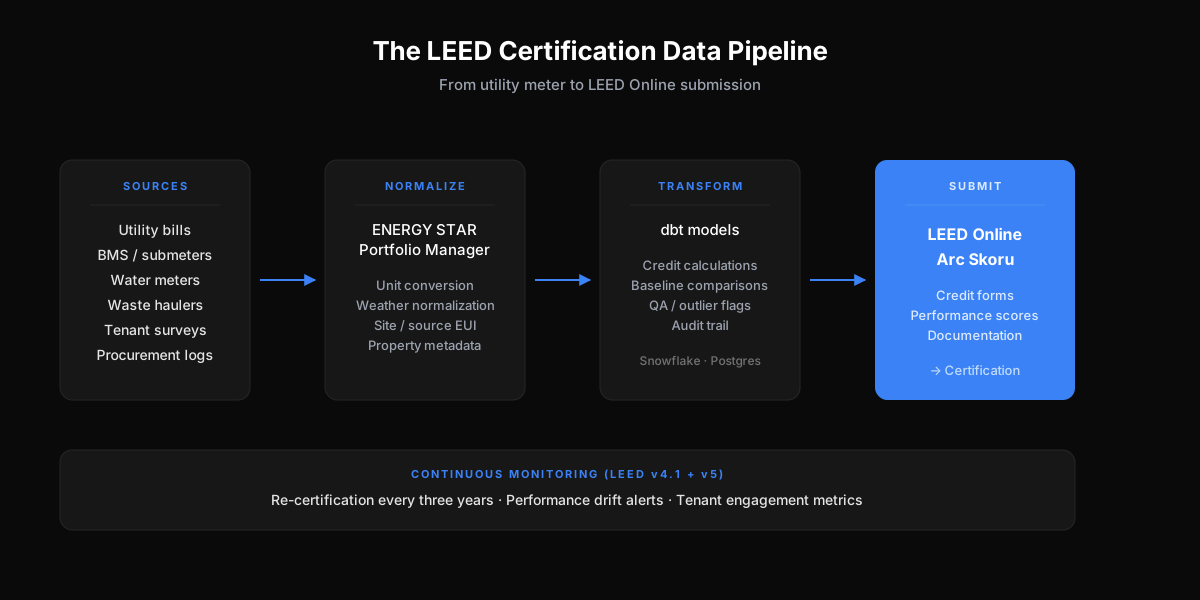
Four stages: sources (where the raw data lives), normalization (where it gets reshaped into a portfolio-comparable form), transformation (where credits are calculated and validated), and submission (where it lands in front of a reviewer). A continuous monitoring layer underpins all of it for v4.1 and v5 performance tracking.
Stage 1: Sources Are Messier Than You Think
A typical mid-size commercial building has six to ten distinct data feeds relevant to LEED: electricity, gas, district steam or chilled water, domestic water, irrigation water, waste haulers, indoor air quality sensors, occupancy badge swipes, transportation surveys, and procurement systems for materials credits.
Almost none of these arrive in the same format. Utility bills come as PDFs (and the PDF parser someone wrote two years ago breaks every time the utility changes their template). Building Management Systems (BMS) export proprietary formats — Tridium Niagara, Johnson Controls Metasys, Honeywell Webs — each with their own time alignment quirks. Waste haulers report tonnage in monthly statements that arrive 30 days late. Tenant surveys live in SurveyMonkey or Google Forms. Procurement logs are in whichever ERP the construction team happened to use.
The first job of the pipeline is to land all of this in one place — usually a cloud object store like S3 or a managed warehouse like Snowflake — without trying to reshape it. Raw fidelity matters because LEED reviewers will sometimes ask to see the underlying source. Throwing away the original PDF to save space is a mistake people only make once.
Stage 2: ENERGY STAR Portfolio Manager Is Your Normalizer
For energy and water credits — which represent the largest single block of LEED points for existing buildings — ENERGY STAR Portfolio Manager (ESPM) is non-negotiable. Whether you love it or hate it, it is the EPA tool that the USGBC anchors performance scoring against, and getting your data into ESPM cleanly is a hard prerequisite.
The good news is ESPM has a Web Services API. The less good news is that it is a SOAP API designed in the 2010s, and most utilities will exchange data with it through one-way feeds that can take weeks to set up. The pragmatic path is a thin Python service that reads from your raw layer, translates units and time intervals to ESPM's expectations, and posts updates on a schedule. Expect to write code for weather normalization, site-vs-source EUI conversion, and property-use metadata that ESPM needs to compare your building to peers.
Treat ESPM as a normalization layer, not a system of record. Your warehouse should hold the raw and normalized values; ESPM holds the EPA-blessed view that goes to LEED.
Stage 3: Credit Calculations Belong in dbt
LEED credits are mostly arithmetic. Reductions versus baselines, percentages of materials sourced regionally, ratios of recycled content, percent reduction in potable water versus a 1.6 GPF baseline. The arithmetic is not hard — but the auditability is.
When a LEED reviewer challenges your Energy Performance score, you need to be able to show: "this number came from this transformation of these source rows, with this baseline assumption, validated against this expected range." If your calculations live in five-tab Excel files emailed between consultants, you cannot defend them.
A dbt project (or any other version-controlled SQL transformation framework) gives you that defense for free. Each credit is a model. Each model has tests for value ranges, completeness, and unit consistency. A QA layer flags outliers before they get into a submission package. The lineage graph dbt produces is itself the audit trail.
For storage we have used both Snowflake and Postgres successfully. Snowflake is overkill for a single building but pays back at portfolio scale where you are joining occupancy, utility, and weather data across hundreds of properties. Postgres works well below 50 buildings.
Stage 4: Submission Is a Document Generation Problem
LEED Online and Arc Skoru are the destinations. LEED Online accepts credit forms, supporting documentation, and narrative responses. Arc handles ongoing performance scoring for v4.1 and v5.
Once your warehouse holds validated credit calculations, generating the submission package is mostly a templating problem. We use Jinja templates (or any document generator) to populate credit form PDFs with values from the warehouse, attach the supporting CSVs, and produce a manifest of every claim with its underlying calculation. This collapses the final submission step from weeks of consultant time to hours of review.
Arc accepts continuous data via API, which means once your pipeline is running daily for v5 performance scoring you can stop thinking about "submission" as a discrete event. The data flows. Your score updates. Re-certification becomes a formality.
What This Architecture Buys You
Defensibility. Every claimed credit traces back to a source row. Reviewer challenges become 15-minute lookups instead of week-long fire drills.
Portfolio scale. Adding a new building is a configuration change, not a months-long onboarding. The same models calculate credits whether you have 5 buildings or 500.
Continuous certification. v4.1 and v5 are explicitly performance-based. A pipeline that already runs daily makes annual re-scoring trivial. The teams still doing this with quarterly Excel rollups will lose to the teams that automated it.
Optionality. The same data also feeds GRESB, SEC climate disclosures, ESG investor reports, and tenant ESG asks. The pipeline pays for itself across compliance regimes.
Common Pitfalls
Throwing away raw data. Compress and archive forever. Storage is cheap; defensibility is priceless.
Letting consultants own the spreadsheets. If your sustainability consultant leaves and your LEED workbook walks out the door, you do not have a process — you have a person.
Skipping the QA layer. A single bad utility-bill OCR can throw an entire credit into question. Every transformation needs a sanity-check test.
Forgetting the human review step. Automation is for the boring 90%. The narrative responses, the credit interpretations, the project-specific judgment calls still need an experienced LEED AP. The pipeline frees them to do that work instead of wrangling CSVs.
Frequently Asked Questions
Do I need ENERGY STAR Portfolio Manager for LEED?
For energy and water performance credits in LEED for Existing Buildings (LEED O+M) and v5, yes. Portfolio Manager is the EPA tool the USGBC anchors performance scoring against. New construction projects can avoid it for some credits, but every building over 25 employees that is pursuing performance-based credits should be using it.
Why use dbt for LEED calculations instead of Excel?
Auditability and defensibility. dbt gives you version-controlled, tested transformations with full lineage from source to credit. When a reviewer challenges a number you can show exactly which rows produced it. Excel cannot do that, and the moment your spreadsheet author leaves the project, the institutional knowledge goes with them.
How long does this pipeline take to build?
For a single building, 3 to 6 weeks if your sources are well documented. For a portfolio of 50 buildings, plan on 3 to 4 months for the first wave, then weeks per additional wave as you templatize source connectors. Most of the time goes into source-system integration, not the warehouse modeling.
Does this work for LEED v5?
Yes — and the architecture pays back more under v5 because v5 expects continuous performance data rather than point-in-time submissions. A pipeline that already runs daily makes v5 trivial; one that runs annually will be a constant scramble.
Need help building your data platform?
At CData Consulting, we design, build, and operate modern data infrastructure for companies across North America. Whether you are planning a migration, optimizing costs, or building from scratch — let's talk.
Get data engineering insights delivered to your inbox
Join our newsletter for weekly insights on Snowflake, data architecture, and modern analytics.