The Semantic Layer Is the Synonym Map: Cutting Time-to-Answer From Days to Minutes
Every executive is asking for self-serve data — type a question, get an answer. The companies shipping it without a governed semantic + synonym layer are shipping a confidence machine that occasionally lies to the CFO. Here is how to build the layer that makes self-serve actually trustworthy.
 Nitin Jain
A client asked us last month: “Why does Finance say revenue was $4.2M and Sales says $4.7M?”
Same quarter. Same company. Different numbers.
The dashboards weren’t broken. The pipelines weren’t broken. The definitions were broken. Finance counted revenue at invoice. Sales counted at contract signature. Both called it “revenue” — and both were technically right inside their own world.
This is the problem a semantic layer is built to solve. And the part most teams miss — the part that actually cuts time-to-answer from days to minutes — is the synonym map sitting on top of it.
Why Definitions Drift
At CData Consulting, the first thing we do on a new analytics engagement is dump every dashboard, scheduled report, and “trusted” SQL snippet into a spreadsheet and tag the metrics. The same business term, calculated six different ways, is the rule, not the exception.
Take “active customer.” We’ve audited environments where it meant:
- Logged in within 30 days (Product team’s definition)
- Has an open invoice (Finance)
- Renewed in the last 12 months (CS)
- Anyone not flagged
is_churned = true(Marketing) - Bought something in the current fiscal year (Sales)
None of these teams were wrong. They were each optimizing for their own decisions. But when the CEO asks “how many active customers do we have?”, the answer depends entirely on which dashboard they happen to open.
Multiply this by every metric — revenue, ARR, MRR, pipeline, retention, CAC — and the data team becomes a permanent translation service.
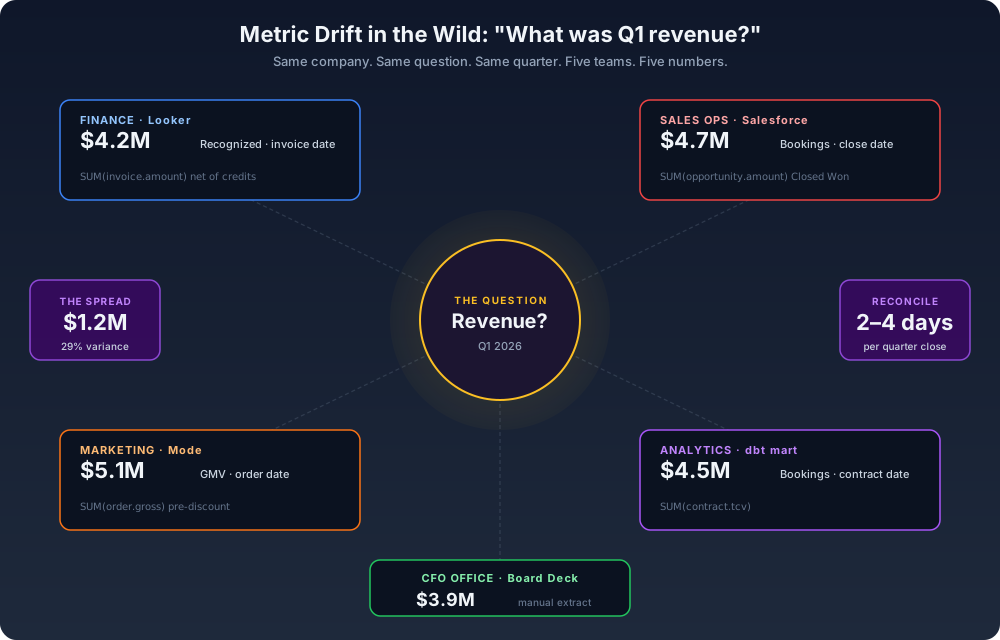
This isn’t a thought experiment. We’ve walked into companies where five teams answer the same revenue question with five different numbers — a $1.2M spread on a quarter that closed two weeks ago. Each team is internally consistent. Together they’re a 2-to-4 day reconciliation tax every quarterly close, and a single point of failure the moment a number reaches a customer or a board.
Free download: The Metric Drift Audit Template
The exact spreadsheet we use on the first day of every engagement to surface how many definitions of “revenue,” “active customer,” and “MRR” exist across your stack. Most teams find 4-7 versions of each.
The Three Layers of a Semantic Layer
Most teams use “semantic layer” to mean Layer 2 only. The teams getting compounding leverage from it build all three.
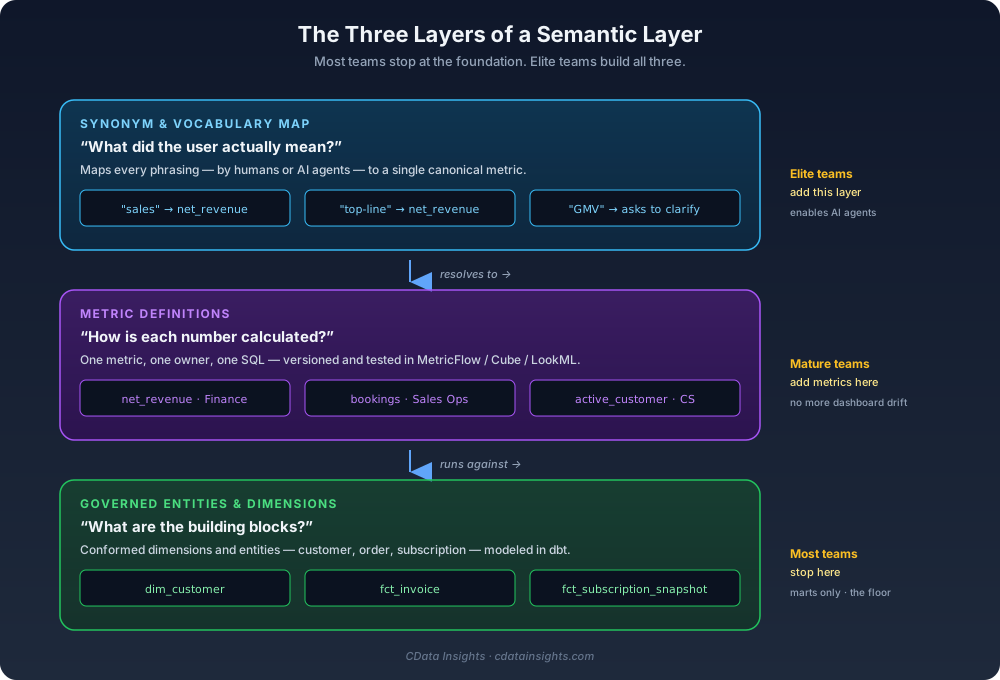
Layer 1 is your modeled data — the dbt marts, the conformed dimensions, the entity tables. Necessary, but not sufficient.
Layer 2 is where you define metrics in code. dbt Semantic Layer, Cube, LookML, MetricFlow — pick your tool. Each metric has a single owner, a single SQL definition, and a list of dimensions it can be sliced by.
Layer 3 is the part that actually accelerates the business: a registry that maps every term humans (and now AI agents) use to the canonical metric.
What the Synonym Map Looks Like
Here’s a stripped-down example of how we structure synonym registration on top of dbt’s MetricFlow:
yaml# semantic_models/metrics/revenue.yml
metrics:
  - name: net_revenue
    description: "Recognized revenue net of refunds and credits"
    type: simple
    owner: finance@cdatainsights.com
    label: "Net Revenue"
    type_params:
      measure: net_revenue_amount

    # The synonym map — this is the leverage
    meta:
      synonyms:
        - "revenue"
        - "net sales"
        - "top line"
        - "recognized revenue"
        - "GAAP revenue"
      ambiguous_with:
        - bookings        # "sales" sometimes means this
        - invoiced_amount # finance team default
      grain: invoice_recognition_date
      excludes:
        - refunds
        - chargebacks
        - intercompany_transfers
When a user — or an LLM — types “what was sales last quarter”, the resolver does three things:
- Looks up “sales” in the synonym map → finds it ambiguous between
net_revenueandbookings - Either disambiguates by context (Finance Slack channel? →
net_revenue. Sales Slack? →bookings) or asks one clarifying question - Issues the canonical SQL against the warehouse
That’s it. No new dashboard. No new mart. Just a layer of governed vocabulary.
Architecture: Where the Synonym Layer Sits
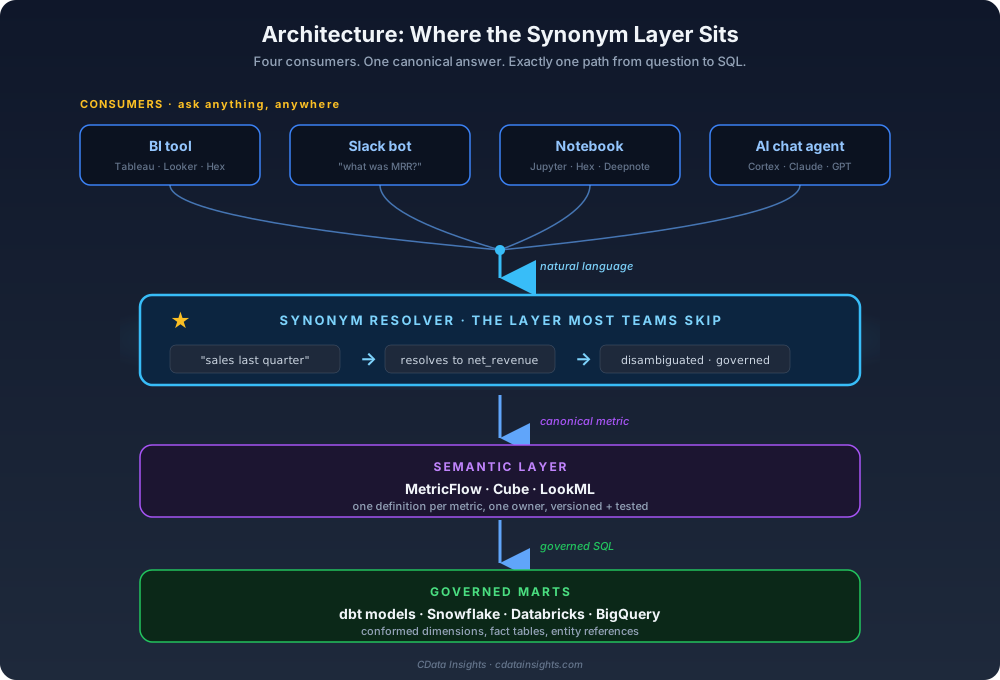
Notice that BI tools, Slack bots, notebooks, and AI agents all hit the same resolver. There is exactly one path from question to SQL. That’s the property that makes the time savings possible.
Where the Time Actually Comes From
The “cutting time” claim is concrete. Here’s where the savings show up on real engagements we’ve run:
1. Ad-hoc questions don’t trigger custom SQL anymore. Before: every Slack ping to the data team becomes a 1-2 day ticket. After: the requester (or the agent in their channel) resolves “active customers in West region this quarter” themselves against the semantic layer. Days → minutes.
2. Reconciliation meetings disappear. Before: weekly sync between Finance, Sales, and RevOps to explain why the numbers don’t match. After: there’s one number. The meeting agenda evaporates.
3. New analyst onboarding collapses. Before: 6 weeks to learn which dashboard is “the real one” for each metric, who owns it, and the gotchas. After: read the metric registry. The institutional knowledge is in code.
4. AI chat agents stop hallucinating. This is the new one — and the reason this layer is suddenly urgent. An LLM pointed at a raw warehouse will guess column names and invent metric definitions. An LLM pointed at a synonym-resolved semantic layer can only return numbers the business has already agreed on. The error rate on a recent client engagement dropped from “we can’t ship this” to “we shipped it to the CFO” once the synonym map was in place.
What We’ve Measured on Real Engagements
These are ranges from CData Consulting client engagements over the last 18 months — not vendor benchmarks:
| Metric | Before | After |
|---|---|---|
| Time-to-answer for ad-hoc questions | 1-3 days | 5-20 minutes |
| Weekly metric reconciliation meetings | 2-4 | 0 |
| Analyst onboarding to productive output | 4-8 weeks | 1-2 weeks |
| Dashboards per metric | 6-12 (drifting) | 1 (governed) |
| Analytics ticket backlog | Growing | -40% to -60% |
These aren’t projections. They’re what happens when the same metric stops being defined by whoever wrote the SQL most recently.
Where do you stand on metric drift?
Most teams we talk to underestimate the scale of their metric drift by 3-5x. We offer a free 60-minute Semantic Layer Strategy Call for data leaders. You’ll leave with a live walkthrough of the audit on one of your metrics, a scoped recommendation on dbt MetricFlow vs. Cube vs. Looker, and a 90-day rollout plan. Limited to 4 calls per month.
The Order of Operations That Actually Works
If you’re standing this up from scratch, sequence matters. We’ve watched teams try to start at Layer 3 and stall — you can’t synonym-map metrics that don’t have stable definitions yet.
- Audit the drift first. Before you build anything, list every metric, who defines it, and the SQL behind each definition. The list will be longer than you expect. Show it to the executive team. The project funds itself.
- Pick canonical definitions, not “best” ones. Don’t try to find the perfect definition of revenue. Pick the one Finance signs off on, document the alternatives as separate metrics (
bookings,invoiced_revenue), and move on. - Build Layer 2 before Layer 3. Get metrics defined in MetricFlow / Cube / LookML and tested. Without stable definitions, the synonym map points at moving targets.
- Register synonyms as you migrate dashboards. Every time you replace a hand-rolled dashboard query, harvest the column names and labels into the synonym map. The map writes itself if you’re disciplined.
- Put the resolver in front of the AI agent last. Once the underlying layer is governed, plugging an LLM into it is the easy part. Without governance underneath, the LLM is just a faster way to be wrong.
Every Board Conversation in 2026: "I Want to Ask the Data Questions Myself"
Walk into any data leader’s office today and you’ll hear the same conversation, just with different titles in the room.
The CFO doesn’t want to file a ticket to ask “what was net revenue in EMEA last quarter, excluding the one-time true-up?” The Head of Sales doesn’t want a meeting to find out “which 10 accounts had the biggest pipeline movement this week?” The CEO doesn’t want a Tableau training session to ask “is our churn accelerating in the SMB segment, year-over-year?”
Every executive we’ve worked with this year has asked some version of the same thing:
“I just want to type my question and get the answer. Why is that so hard?”
It’s not hard. It’s a semantic-layer problem dressed up as an AI problem.
The Trap Most Teams Are Walking Into
Vendors are racing to sell the answer: Snowflake Cortex Analyst, dbt Semantic Layer + AI, Cube AI, ThoughtSpot Sage, Hex Magic, Databricks Genie, custom GPT and Claude integrations on top of the warehouse. The pitches all sound the same — natural language in, governed answer out.
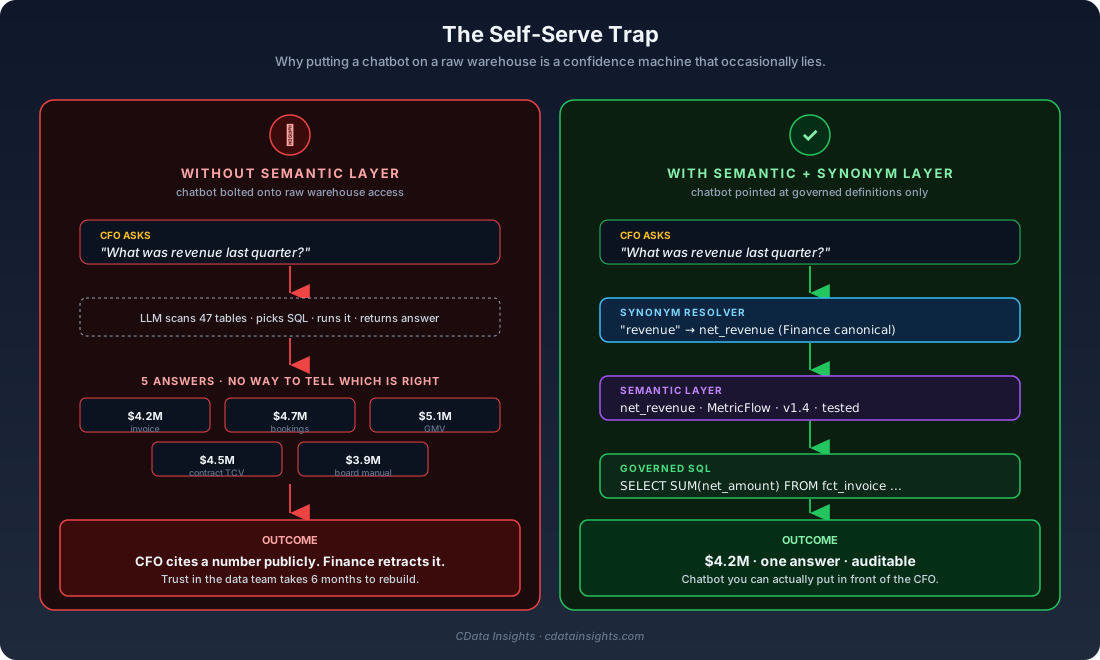
Companies are buying these tools and bolting them onto warehouses that have no agreed-on definitions. The result is predictable:
- The CFO asks “what was revenue?” The agent picks the Sales team’s bookings number. The CFO cites it publicly. Finance has to retract.
- The Head of Product asks “active users last week?” The agent returns Mixpanel’s MAU. Product Marketing was using a different definition for the launch report. Two decks contradict each other in the same all-hands.
- The CEO asks “what’s our LTV?” The agent picks one of three formulas in the warehouse. The board deck shows a fourth.
The chatbot isn’t wrong — it’s returning something that’s true somewhere in the data. The problem is that “somewhere” has fifteen versions of the answer, and the system has no way to know which is canonical.
What a Real Self-Serve Layer Requires
The self-serve dream — type a question, get a trustworthy answer — only works when three things are true:
- One canonical definition per metric (Layer 2 of the semantic layer)
- A synonym map that resolves every phrasing of the question to that definition (Layer 3)
- An AI agent constrained to only those definitions, refusing to invent SQL on the fly
Skip any of these and you ship a confidence machine that occasionally lies to the CFO.
The companies getting self-serve right in 2026 built the semantic layer first, then put the chatbot on top. The companies struggling bought the chatbot first and are now retro-fitting governance underneath while it’s already in production.
Why This Matters More Than It Did Two Years Ago
You could survive without a semantic layer when the only consumers were BI tools and trained analysts. The analysts knew which dashboard to trust. The BI tool ran whatever SQL the LookML compiled.
That’s no longer the consumer profile. The consumers now include:
- Slack bots answering “what’s MRR?” in a channel
- AI agents writing SQL on the fly against the warehouse
- Embedded analytics inside customer-facing products
- Executive copilots synthesizing across dozens of metrics in a single answer
None of these consumers can be trained the way an analyst can. They will return whatever the system tells them is true. If the system has fifteen versions of “revenue” and no synonym map, you will ship fifteen versions of “revenue” to fifteen surfaces — and the moment one of them is wrong in front of a customer, the credibility hit lands on data engineering.
The semantic layer with a governed synonym map is what makes AI on top of your data trustworthy. Without it, the chatbot is a liability dressed as a feature.
The Practitioner’s Takeaway
If your team is still arguing about whose number is right, you don’t have a BI problem. You have a definition problem.
A semantic layer fixes the definitions. A synonym map fixes the language people (and agents) use to ask for them. Together, they’re the difference between a data org that translates and a data org that ships.
The time savings — days to minutes, weeks to days — aren’t the goal. They’re the side effect of having one source of truth and one vocabulary to query it with. Get that right and the rest of the modern data stack actually starts to compound.
Frequently Asked Questions
Can I put a chatbot on my warehouse without a semantic layer?
You can, and lots of teams have. They tend to regret it. An LLM pointed at raw tables guesses column names, picks one of several possible SQLs, and returns a number with high confidence. With no canonical metric definitions underneath, there is no way for the agent — or the executive reading the answer — to know which of the warehouse’s 4-7 versions of “revenue” got returned. The chatbot demos well in week one and embarrasses you in month six. If self-serve AI is on your roadmap, the semantic + synonym layer is the prerequisite, not the follow-up.
What is the difference between a data catalog and a semantic layer?
A data catalog (Atlan, Collibra, DataHub) tells you what data exists and who owns it — it is a metadata index. A semantic layer (dbt MetricFlow, Cube, LookML) defines how metrics are computed and how they can be queried. You need both. The catalog answers “does this column exist?” The semantic layer answers “how is revenue calculated?”
Should I use dbt MetricFlow, Cube, or LookML for my semantic layer?
Short answer: if your warehouse is the system of record and your team already lives in dbt, use dbt MetricFlow. If you need an open API that powers BI, embedded analytics, AI agents, and Excel from one place, Cube is the most flexible. LookML is excellent if you are already deep in Looker and not planning to leave. The decision depends more on your consumer profile than your warehouse.
How long does it take to stand up a semantic layer with a synonym map?
For a mid-sized data team with existing dbt marts, 4-6 weeks: week 1 audit and canonical definition workshop with stakeholders, weeks 2-4 implementation in MetricFlow or Cube, weeks 5-6 synonym map and AI agent integration. The bottleneck is rarely engineering — it is getting Finance, Sales, and RevOps to agree on canonical definitions.
Why is the synonym map suddenly so important for AI?
An LLM pointed at a raw warehouse will guess column names, invent metric definitions, and confidently return wrong numbers. An LLM pointed at a synonym-resolved semantic layer can only return values the business has already agreed on. The synonym map is the layer that turns a chatbot from a liability into a feature you can put in front of an executive.
Can we adopt this incrementally, or does it have to be all-or-nothing?
Incrementally. Start with one metric and one consumer surface. Pick the metric that drifts the most — usually revenue or active customer — and the surface where wrong numbers cost you the most. Govern that one end-to-end. Then expand. Trying to define every metric at once stalls because canonical-definition workshops require executive time you do not have a budget for in week one.
Need help building your data platform?
At CData Consulting, we design, build, and operate modern data infrastructure for companies across North America. Whether you are planning a migration, optimizing costs, or building from scratch — let's talk.
Get data engineering insights delivered to your inbox
Join our newsletter for weekly insights on Snowflake, data architecture, and modern analytics.