Data Governance Without the Bureaucracy: Quality Built Into the Pipeline
Most data governance programs fail because they live in PowerPoint, not in the pipeline. Here is the federated, in-pipeline model that actually catches bad data before it reaches stakeholders.
 Nitin Jain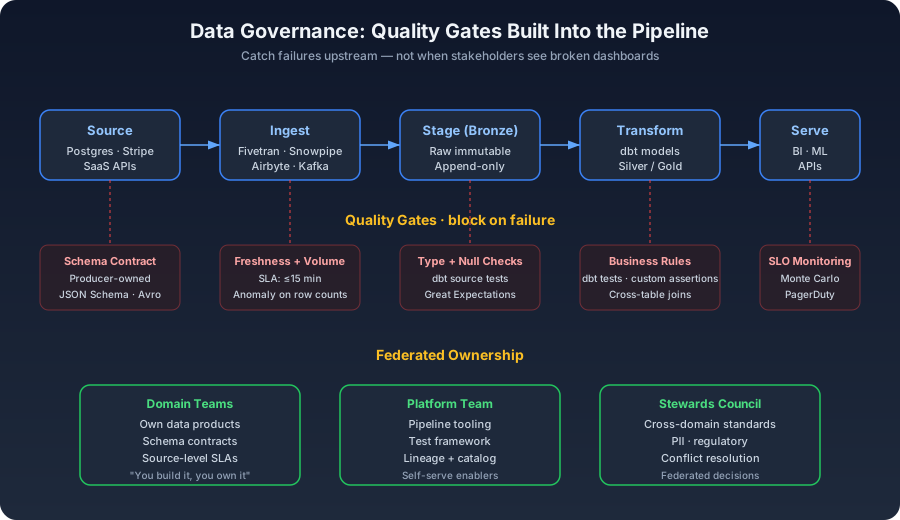
Most data governance programs do not survive contact with reality. They start as a 40-page framework deck, get a kickoff with the heads of every domain, and end as a Confluence space nobody opens. Six months later the same data quality problems are still landing in the same Slack channels, and the next governance initiative is being scoped by a different VP.
This is not because governance is a bad idea. It is because traditional governance tries to enforce policy after data is in the warehouse, through committees and review boards. By that point the bad data has already shipped, and the review boards become bottlenecks that the rest of the org learns to route around.
Why traditional governance fails
Top-down policy without enforcement is theater. If the rule is "all PII columns must be tagged" but nothing breaks when they are not tagged, the rule is decorative.
Centralized review creates dependencies. When every schema change requires a governance committee sign-off, teams either wait weeks for trivial changes or work around the process entirely.
Quality issues are caught downstream. The classic failure mode: a producer ships a schema change, ingest succeeds, the silver layer transforms cleanly, the dashboard renders — and is silently wrong because the change broke a join key. Stakeholders find out before the data team does.
The shift: governance as code, embedded in the pipeline
The model that actually works is the inverse of the committee model. Instead of governance as policy reviewed by humans after the fact, governance becomes quality gates that run with every pipeline execution. If the gate fails, the pipeline stops. The bad data never reaches the next stage.
Five gates, in order of when they run, will catch roughly 95 percent of the issues that show up in production.
1. Schema contract at the source
A schema contract is a producer-owned, machine-readable description of the data the producer is promising to send: column names, types, nullability, and acceptable enum values. It can be JSON Schema, an Avro spec, a Protobuf definition, or even a dbt source YAML. The point is that it is checked before ingest, not after, and the producer is on the hook to update it before changing the data.
In practice: every source has a contract checked in alongside the ingestion job. The first thing the job does is validate incoming records against the contract. Mismatches block ingestion and page the producer team, not the data team.
2. Freshness and volume
The two cheapest, most useful checks: did the data arrive on time, and is the volume in the expected range? These catch upstream outages (no data) and silent failures (data arrives but at 10 percent of normal volume because a partition got truncated). Most modern observability tools (Monte Carlo, dbt source freshness, Lightup) handle this out of the box. The mistake teams make is treating these as nice-to-haves rather than blocking gates.
3. Type and null checks at stage
Once data is in your bronze/staging layer, run mechanical checks: are the types what you expect, are required columns non-null, are foreign keys actually present in the dimension table? dbt source tests covers most of this declaratively. Great Expectations is the heavyweight option when you need cross-row assertions.
4. Business rules at transform
These are the assertions that depend on domain knowledge: revenue should never be negative, churn rate should be between 0 and 1, the sum of cohort counts should equal the total user count. Encode them as dbt tests or custom SQL assertions that run on every model build. Make them block deploys, not just emit warnings.
5. SLO monitoring at serve
For tables that power dashboards or APIs, define and monitor SLOs: 99 percent of queries return in under 5 seconds, the table is fresh within 30 minutes, the row count is within ±5 percent of the prior period. Wire these to PagerDuty so an SLO breach pages someone, the same way a service outage would.
Federated ownership: who owns what
Quality gates are necessary but not sufficient. Without clear ownership, every gate failure becomes a fire drill where nobody knows who should fix it. The model that holds up over time is federated.
Domain teams own their data products. The team that produces orders data owns the orders schema contract, the orders source-level SLA, and the orders quality gates. They are on call when those gates fail. This is the "you build it, you own it" principle from operational software, applied to data.
Platform team owns the enablers. The framework for declaring contracts, the test runner, the lineage tooling, the catalog. The platform team does not own anyone else's data — they make it cheap and obvious for domain teams to do the right thing.
Stewards council handles the cross-domain stuff. PII classification, regulatory requirements (GDPR, CCPA, PIPEDA), conflict resolution between domains. The council does not approve every change — it sets the standards and adjudicates when domains disagree.
Quality metrics that actually matter
The classic five — completeness, accuracy, consistency, timeliness, validity — are still the right framework. The trick is to instrument them, not just talk about them.
Completeness: percentage of expected rows that arrived. Anomaly-detected per table.
Accuracy: percentage of rows that pass business-rule tests. Tracked over time per table.
Consistency: referential integrity across tables. Foreign keys, dimension joins, cross-source reconciliation.
Timeliness: latency from source event to availability in serving table. Compared against the SLO for that table.
Validity: percentage of rows that conform to the schema contract. Should be 100 percent if the upstream gate is doing its job.
The toolchain
You do not need to buy everything. A reasonable starting stack:
dbt for tests and source freshness — covers gates 2, 3, and 4 declaratively. Great Expectations or Soda when you need cross-row, distribution-shape assertions that dbt cannot easily express. Monte Carlo, Lightup, or Bigeye for ML-based anomaly detection on freshness and volume — gate 2.
OpenMetadata, DataHub, or Atlan for lineage and catalog — required for stewards to do their job. PagerDuty or Opsgenie for SLO breach paging, wired to the same on-call rotation that owns the data product.
How to start
Do not try to roll out all five gates across all pipelines at once. The fastest way to kill a governance program is to make it a 12-month transformation project. Pick the pipeline that is causing the most pain — usually the one whose dashboards your CEO complains about — and instrument it end to end. Get all five gates green. Use that pipeline as the reference implementation when domain teams ask "what does this look like in practice?"
Then expand. Within six months you can have most of the critical pipelines under quality gates. Within a year, all of them. Bureaucratic governance programs spend the same year arguing about org charts.
Frequently Asked Questions
Where do data contracts fit into this model?
They are gate 1 — the schema contract at the source. A data contract is a producer-owned, machine-readable description of the data the producer commits to send. It is the specific mechanism by which schema-level governance gets enforced at ingestion time rather than reviewed after the fact.
How is this different from a traditional data governance committee?
A committee writes rules and reviews changes. This model writes rules as code and runs them automatically with every pipeline execution. The committee model creates bottlenecks; this model creates self-service guardrails. Both have stewards — the difference is that here the stewards set standards and adjudicate disputes, rather than approving every individual change.
What if my team does not have a platform team?
Start with dbt tests. Source freshness, source tests, and model tests will get you to roughly 60 percent of the value with no platform team and no new tools. Add lineage and a catalog when you have more than ten producers. Add a stewards council when you have more than three domains.
How do I get domain teams to actually own their data quality?
Two things. First, gate failures have to page the domain team, not the central data team. As long as the central team absorbs the alerts, the domain team has no incentive to fix the source. Second, executive air cover — leadership needs to make data product ownership a job-description-level expectation, not a volunteer activity.
Need help building your data platform?
At CData Consulting, we design, build, and operate modern data infrastructure for companies across North America. Whether you are planning a migration, optimizing costs, or building from scratch — let's talk.
Get data engineering insights delivered to your inbox
Join our newsletter for weekly insights on Snowflake, data architecture, and modern analytics.