DBT + Airflow at Scale: What Breaks After 200 Models (and How to Fix It)
The patterns that work at 50 models collapse at 200+. Here is what production DBT + Airflow architectures actually look like at high-growth companies.
 Nitin Jain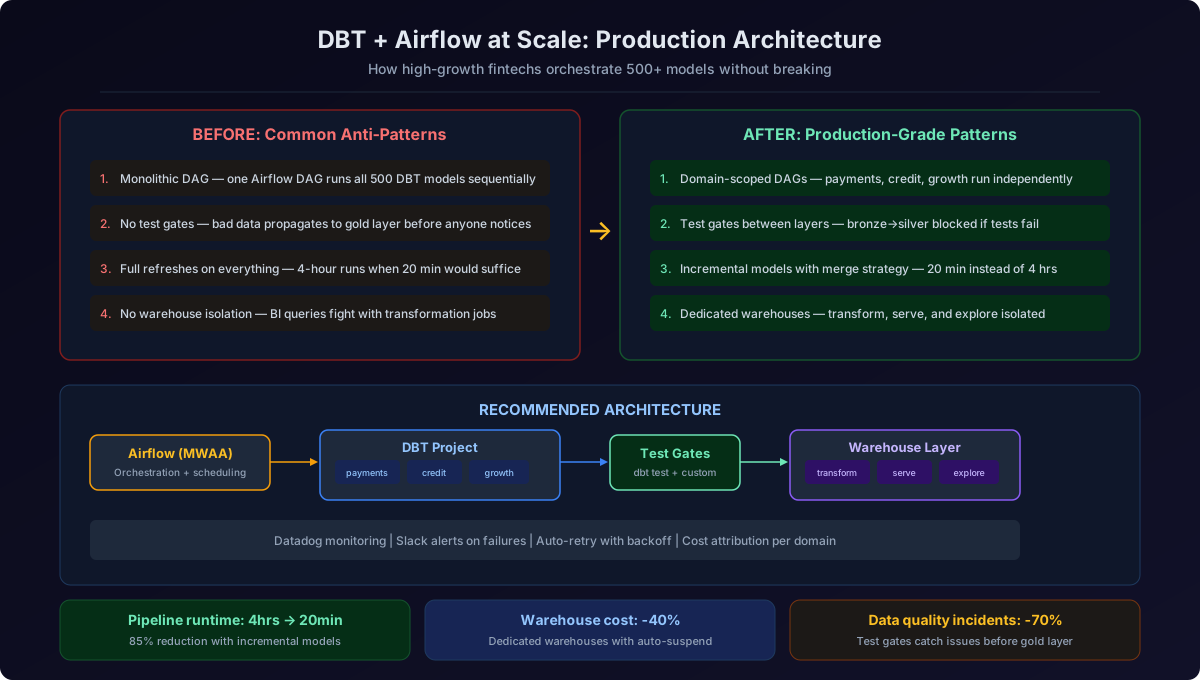
DBT and Airflow have become the default stack for modern data teams. At 50 models the combination is straightforward. At 200+ models with multiple domains, production SLAs, and a team that has tripled in size, the cracks start to show. This is not a tool problem — it is an architecture problem.
What Breaks at Scale
The first thing to collapse is the monolithic DAG. Most teams start with a single Airflow DAG that triggers a dbt run command across the entire project. At 50 models this completes in minutes. At 200+ models with complex cross-references, you are looking at multi-hour runs where a failure in one domain cascades across the entire pipeline. Your payments team is waiting on a fix in the growth domain's staging models.
The second failure is the absence of test gates. Teams run dbt test as a post-processing step after all models have built. By the time a data quality issue is caught, bad data has already propagated to gold-layer tables that feed dashboards and regulatory reports. Rolling back becomes a multi-hour exercise.
The third issue is full-refresh overuse. Teams default to full refreshes because incremental models require more upfront design. At scale, this means rebuilding hundreds of millions of rows nightly when only a fraction changed. A 4-hour pipeline becomes a blocker for morning dashboards and downstream ML training jobs.
Pattern 1: Domain-Scoped DAGs
Break the monolithic DAG into domain-scoped DAGs that can run independently. Payments, credit risk, growth, and customer analytics each get their own Airflow DAG with their own schedule, retry logic, and alerting. Use DBT's selector syntax (dbt run --select tag:payments) to scope each run. Cross-domain dependencies are managed through DAG sensors or shared completion markers, not sequential execution.
The benefit is isolation. A failure in the credit risk pipeline does not block the growth team's morning dashboards. Each domain team owns their pipeline's schedule and SLA. Debugging moves from "which of 500 models failed" to "the payments pipeline failed at the silver layer."
Pattern 2: Test Gates Between Layers
Insert test gates between each medallion layer. After bronze models build, run dbt test on those models. Only if tests pass does the DAG proceed to silver. This prevents bad data from propagating downstream. The most effective test gates combine DBT's built-in tests (not null, unique, accepted values, relationships) with custom tests for business logic — transaction amounts within expected ranges, date fields not in the future, foreign key integrity across domains.
For critical pipelines, add a "circuit breaker" pattern: if the same test fails three consecutive runs, halt the pipeline and page the on-call engineer rather than silently retrying. This catches systemic upstream data issues before they become production incidents.
Pattern 3: Incremental Models With Merge Strategy
The transition from full refresh to incremental models is where most of the performance improvement lives. For fact tables (transactions, events, logs), use an incremental model with a merge strategy keyed on the natural key plus event timestamp. Process only rows where the source's updated_at exceeds the model's max updated_at.
For slowly changing dimensions, use DBT snapshots with a timestamp strategy. This preserves history while only processing changed records. The combination of incremental facts and snapshot dimensions can reduce a 4-hour full-refresh pipeline to 20 minutes while maintaining complete data history.
Pattern 4: Warehouse Isolation
Run transformation workloads on a dedicated warehouse (or Redshift workload management queue) that is separate from the warehouse serving BI queries. This prevents a large dbt run from competing with analyst queries for compute resources. On AWS, this means separate Redshift Serverless workgroups or dedicated provisioned clusters for transform vs. serve workloads. Add a third "explore" warehouse for ad-hoc queries with aggressive auto-suspend policies.
The cost impact is counterintuitive: warehouse isolation often reduces total spend because each workload gets right-sized compute instead of one oversized cluster running everything. Teams we have worked with typically see 30–40% warehouse cost reduction after implementing workload isolation.
Monitoring and Alerting
At scale, you need three categories of monitoring. Pipeline health: Airflow task duration trends, failure rates, and SLA misses pushed to Datadog or your observability platform. Data quality: dbt test results tracked over time to identify degradation before it becomes an incident. Cost attribution: per-domain warehouse spend so each team understands and owns their compute footprint.
The combination of Slack alerts on pipeline failures, weekly data quality reports, and monthly cost reviews per domain creates accountability without micromanagement. Data platform teams shift from firefighting to proactive optimization.
When to Invest in This
If your dbt project has crossed 100 models, you are hiring your third or fourth data engineer, and your pipeline runtime has quietly grown to over an hour — you are at the inflection point. The patterns above are significantly cheaper to implement proactively than to retrofit after a production incident during a board-level data review.
Frequently Asked Questions
When should you break a monolithic DBT project into domain-scoped DAGs?
When you exceed 100 models, have multiple teams contributing to the project, or when pipeline failures in one domain regularly block another team's work. The threshold is more about team structure than model count — if two independent teams share a single DAG, it is time to split.
How do incremental models reduce pipeline runtime?
Incremental models only process new or changed rows instead of rebuilding entire tables. For a table with 100 million rows where 500K change daily, incremental processing handles 0.5% of the data instead of 100%. This typically reduces pipeline runtime by 80–90%.
Does warehouse isolation increase costs?
Typically no — it reduces costs by 30–40%. Each workload gets right-sized compute instead of sharing one oversized cluster. Transform warehouses can use aggressive auto-suspend, and explore warehouses can use spot/serverless pricing.
Need help building your data platform?
At CData Consulting, we design, build, and operate modern data infrastructure for companies across North America. Whether you are planning a migration, optimizing costs, or building from scratch — let's talk.
Get data engineering insights delivered to your inbox
Join our newsletter for weekly insights on Snowflake, data architecture, and modern analytics.