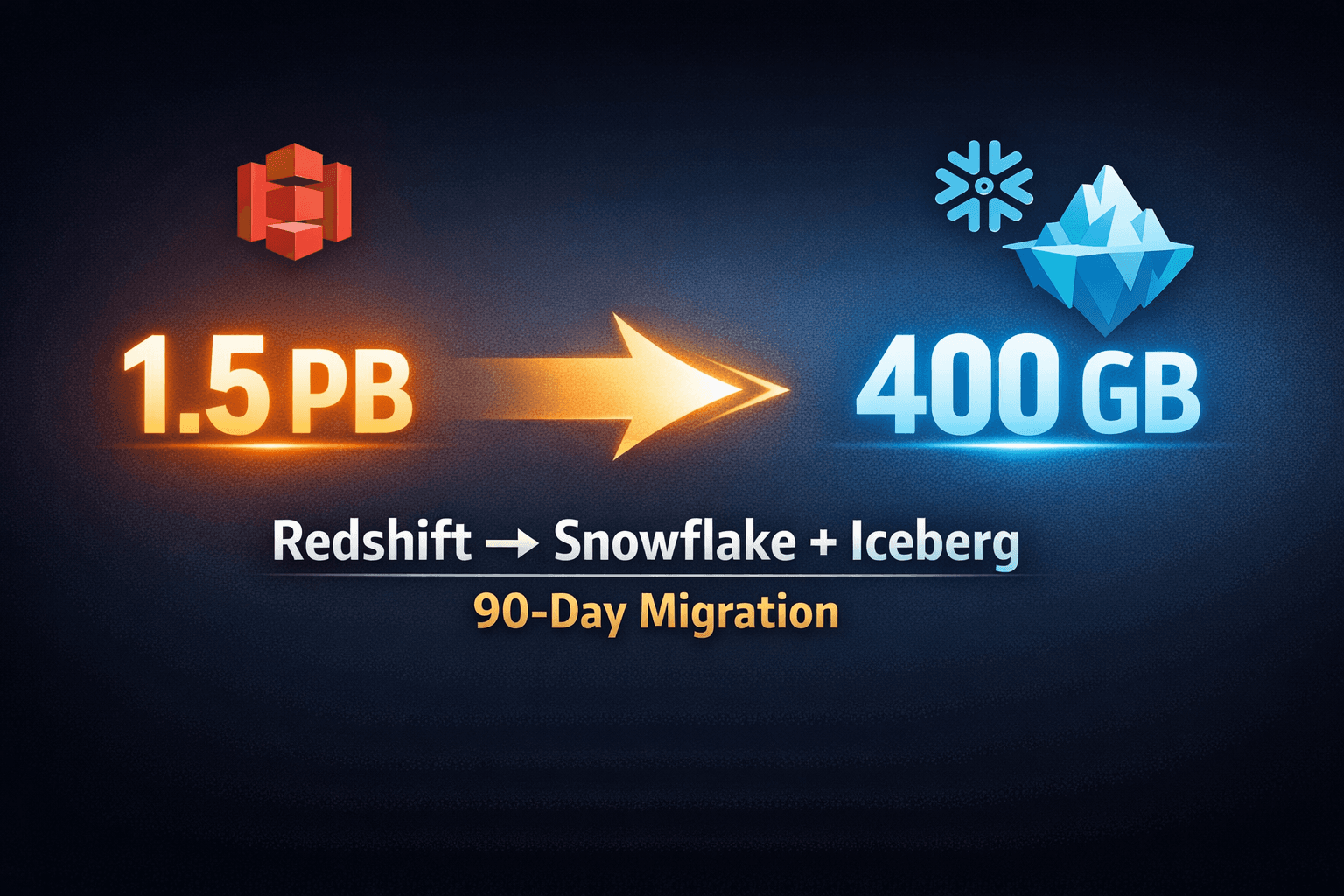
1.5 PB to 400 GB: Redshift to Snowflake + Apache Iceberg
How we migrated 1.5 petabytes from Redshift to Snowflake + Iceberg in 90 days, achieving a 73% storage reduction with zero data loss.
A data engineering team successfully migrated 1.5 petabytes from Amazon Redshift to a modern Snowflake and Apache Iceberg stack in 90 days, achieving a 73% storage reduction to approximately 400 GB.
Key Challenges Addressed
The client faced three critical issues: high operational costs at massive scale, vendor lock-in with Redshift’s proprietary format, and significant engineering overhead managing cluster infrastructure. The largest single table reached 169 TB, presenting a high-risk migration component.
Architecture & Technologies
The solution leveraged Snowflake for compute and Apache Iceberg as an open table format on S3, with Python extraction pipelines converting data to compressed Parquet format using Zstd compression.
This combination provided open table format compatibility across multiple engines, efficient columnar storage with high compression ratios, separation of compute and storage for cost optimization, and schema evolution and time-travel capabilities via Iceberg.
Migration Phases
Phase 1: Data Audit (Weeks 1–2)
Complete data audit identifying compression inefficiencies and redundant records. This initial assessment revealed significant opportunities for storage optimization through proper encoding and deduplication.
Phase 2: Pipeline Development (Weeks 3–10)
Automated pipeline development with parallelized ingestion and row-level validation for the 169 TB table. Key engineering decisions included parallel extraction splitting large tables into manageable chunks, incremental validation with row-level checksums to ensure data integrity, Zstd compression for optimal balance between compression ratio and speed, and Parquet format for columnar storage enabling efficient analytical queries.
Phase 3: Cutover (Weeks 11–12)
Parallel system operation with identical query validation before cutover. Both systems ran simultaneously, with automated comparison of query results to ensure consistency.
Outcomes
Storage reduced 73% through compression and data deduplication. Zero data loss and zero unplanned downtime. The platform is now vendor-neutral with Iceberg’s open format, with improved query performance on analytical workloads and significantly reduced operational complexity.
Key Takeaway
The migration demonstrated that even at petabyte scale, a well-planned transition to modern open formats can deliver dramatic cost savings while simultaneously improving performance and eliminating vendor lock-in. The key was thorough upfront analysis, automated validation pipelines, and a phased approach that minimized risk at every step.
Frequently Asked Questions
How long did the migration take?
The entire migration from Redshift to Snowflake + Apache Iceberg was completed in 90 days, divided into three phases: data audit, pipeline development, and cutover.
How was data integrity ensured during migration?
Row-level checksums and automated query comparison between both systems running in parallel ensured zero data loss throughout the migration.
Need help building your data platform?
At CData Consulting, we design, build, and operate modern data infrastructure for companies across North America. Whether you are planning a migration, optimizing costs, or building from scratch — let's talk.